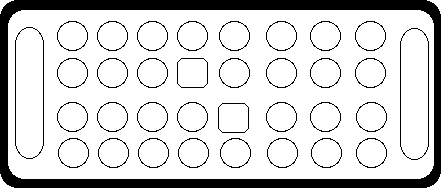
The board is set up with two stones in each cup.
Easy, eh? I'll illustrate a few moves. The point-of-view (clockwise or anti-clockwise) is always from the player's perspective, but I will refer to positions on the board from a single point-of-view: that presented in the diagram.
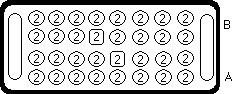 | The board is set up for play, two stones in each hole. Player 'A', at the bottom of the board is going to play, and will select the stones from the outer [bottom] row, second from the right |
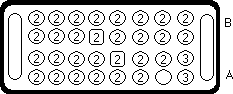 | 'A' has taken the stones from his outer row, second from the right, and distributed them, one by one, in an anti-clockwise direction, finishing at the first hole in the inner row. There are stones belonging to his opponent in the adjacent hole, so he will capture them |
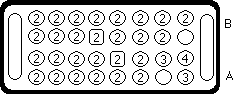 | 'A' takes the stones from the right-most hole of his opponent's inner row, and re-distributes them in his own inner row, starting from the right and going in an anti-clockwise direction. He finishes the move in the hole second from the right, opposite more stones belonging to his opponent, and will capture them for the next move |
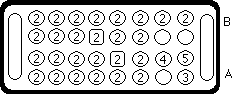 | A' captures the stones and once again re-distributes them anti-clockwise into his own inner row, starting from the rightmost hole. His last stone lands in the second hole, which is opposite 'B's empty hole - no capture this time |
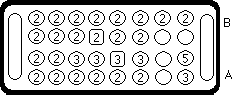 | Because he landed in a hole with stones, 'A' continues to play, picking up the stones from where he last landed (second from the right) and re-distributing them anti-clockwise in the next four holes. He ends in the hole third from the left, opposite 'B's stones, which he will capture |
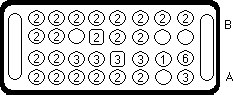 | 'A' takes the two captured stones and redistributes them anti-clockwise, starting from the right, along his inner row of holes. They end in the second hole from the right, which is empty, and play passes to 'B' |
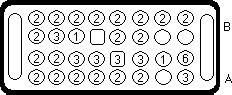 | 'B' chooses the stones in his inner row, fourth from the left, and distributes them clockwise, terminating in the hole second from the left and opposite 'A's stones, which he will capture |
 | Because the capture was in a hole second to the end, when 'B' re-distributes the stones he changes direction, now going anti-clockwise, starting from the leftmost hole in his inner row. The last stone lands in the hole second from the left, with no stones opposite to capture |
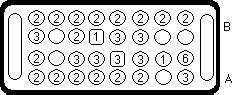 | 'B's last move landed in a hole with stones, so he just picks them up, and continues in the same direction (anti-clockwise, now), along his own inner row, ending in the hole third from the right, opposite three of 'A's stones. He captures them |
 | The captured stones are re-distributed, still in an anti-clockwise direction. His last stone lands in the hole third from the left, and he captures his opponent's stones, opposite |
 | Again, the captured stones are distributed anti-clockwise, ending again at the third hole from the left. There are no stones to capture |
 | 'B's last move landed in a hole with stones, so he just picks them up, and continues in the same direction. His last stone lands in the empty hole second from the right, and play passes back to 'A', who will probably go anti-clockwise, starting inner row, fourth from the left, capture 5 stones, switch direction to clockwise, come back, capture 4 stones, redistribute them, and so forth and so on.... |
Want to have a try? A first attempt at writing a Javascript version of Bão is provided for your enjoyment.
What about the funny square holes and the holes on the sides? They are used in an extension of the game, where the stones aren't pre-distributed but are played from those holes onto the board. I'm afraid we didn't learn that bit.
Incidently, this is just what we gleaned from our playing of the game. If anyone has a better description, or knows the rules better than this, please feel free to let us know, and we'll update this page.